Rice Cooker Glossary: Japanese Rice Texture & Hardware Terms
This rice cooker glossary gives plain explanations of the hardware terms (Micom, Induction Heating, GABA Brown, Go cup) and the everyday Japanese texture and surface words (bechabecha, kachikochi, zaratsuita, tsurutsuru, bukubuku, shamoji) I use in my Zojirushi NL-EAC18BA review, my rice grain size & starch guide, and across this site.
Bechabecha (ベチャベチャ)
Japanese Texture WordWet, soggy, waterlogged rice. When it happens only around the outer edge of the pot, it is caused by steam condensing on an uninsulated lid and dripping back down onto the rice. When it happens across the whole pot, it is caused by using too much water or waiting too long to fluff after cooking.
Bukubuku (ぶくぶく)
Japanese Boiling WordThick, bubbling starchy foam that clogs small steam vents and spits out onto the kitchen counter. Prevented by rinsing rice 3 to 4 times and using a cooker with a deep removable steam vent cap.
Extended Keep-Warm
Rice Cooker FeatureA secondary Zojirushi keep-warm mode that holds cooked rice at a slightly lower, moisture-saving temperature than regular Keep-Warm to reduce yellowing and drying over 12 to 24 hours.
Fuzzy Logic / Neuro Fuzzy
Control SystemA microcomputer program that reads thermal sensors in the bottom and lid of a rice cooker to adjust soaking time, boiling heat, and steaming time based on batch size.
GABA Brown Rice (発芽玄米)
Grain SettingGamma-aminobutyric acid brown rice. When selected on a cooker like my Zojirushi NL-EAC18BA or the NP-HCC10XH, the pot holds brown rice in warm water (~104°F / 40°C) for two hours before boiling, softening the bran and boosting nutrients.
Go (合)
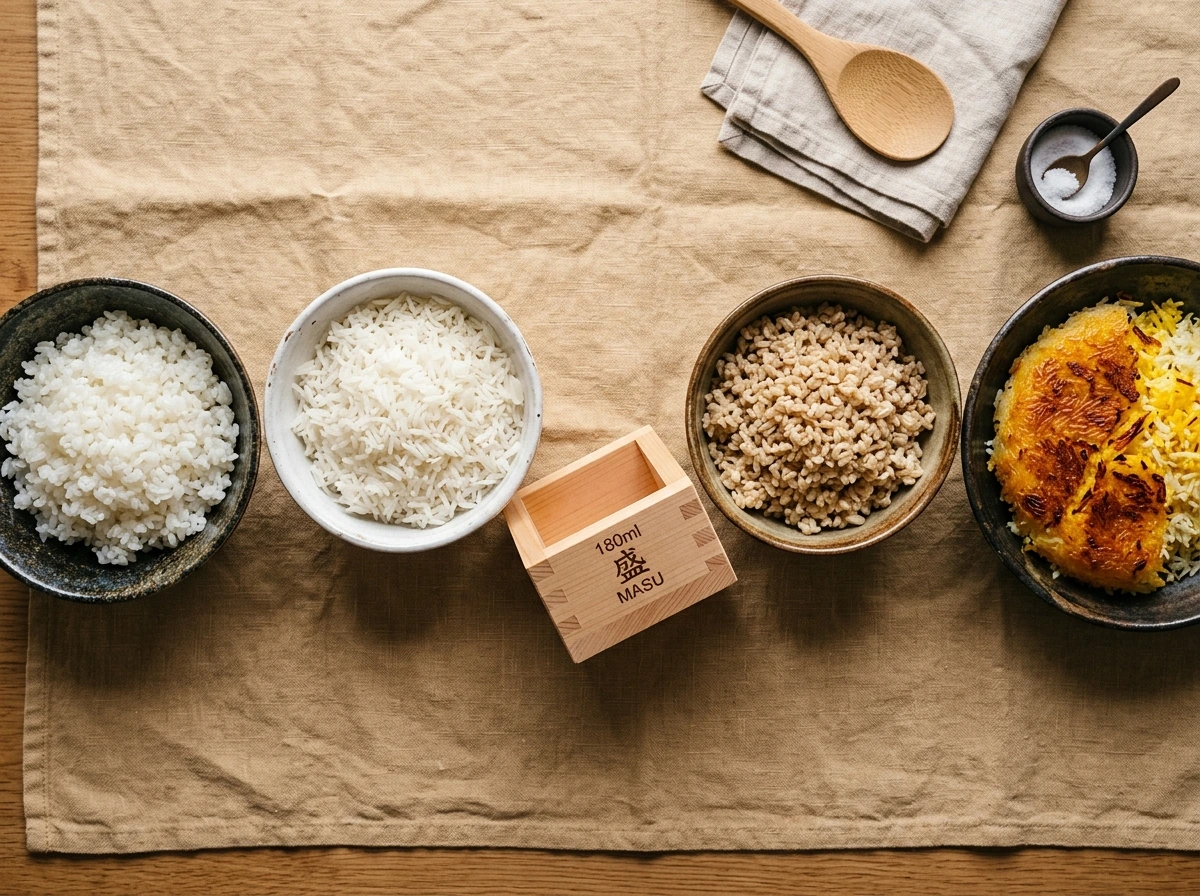
Measurement UnitThe traditional Japanese unit of volume used to measure uncooked rice and sake. One go equals 180 milliliters (about 6.1 US fluid ounces, or 3/4 of a standard 240 ml US cup). A "5.5-cup" or "10-cup" Japanese rice cooker is a 5.5-go (1.0L) or 10-go (1.8L) cooker.
Hogushi (ほぐし)
Cooking StepSlicing and gently folding cooked rice with a paddle right after the rice cooker finishes its cycle so extra bottom steam escapes instead of turning into wet pockets.
Induction Heating (IH)
Heating SystemA heating system that uses high-wattage (1,080W to 1,350W) magnetic coils underneath and around the pot to turn the metal inner pan itself into the heater, giving faster response and more even heat than a bottom hot plate.
Kachikochi (カチコチ)
Japanese Texture WordRock-hard, dried-out, crusty rice. Often happens when rice is left on Keep-Warm in a basic one-switch cooker whose bottom heating plate runs too hot, or when the lid is left slightly open.
Micom (マイコン)
Control SystemShort for "microcomputer." A Micom rice cooker uses a digital chip and thermal sensor to control a bottom heating plate, lid heater, and side heater through pre-soak, boil, steam, and keep-warm stages.
Musenmai (無洗米 / Rinse-Free Rice)
Rice TypeShort-grain white rice that has had its sticky surface bran polish removed at the mill so it does not need washing before cooking.
Nurungji (누룽지 / Scorched Rice)
Korean Rice Dish & SettingA traditional Korean preparation where the bottom layer of rice in the pot is toasted into a crisp, nutty golden crust. Available as a one-button setting on Cuckoo rice cookers like the CR-0675F and CRP-RT0609FW.
Shamoji (しゃもじ)
Kitchen ToolThe flat rice paddle used to fluff and serve rice. My Zojirushi NL-EAC18BA includes a self-standing shamoji that stands upright on the counter, though despite its embossed surface, rice still sticks to it a bit unless you dip it in water.
Shinmai (新米 / New-Crop Rice)
Rice TypeFreshly harvested autumn rice. Because new-crop rice holds more natural moisture inside the grain, Japanese cooks pour water 1 to 2 millimeters below the pot line so the rice does not come out too soft.
Tacook
Tiger FeatureTiger's BPA-free cooking tray that rests in the top of the inner pot, letting rising steam from the cooking rice below cook fish, chicken, or vegetables at the same time without dripping juices into the grain.
Tsurutsuru (ツルツル)
Japanese Surface WordSlick, smooth, glossy surface texture (like shiny white plastic appliance bodies).
Zaratsuita (ざらついた)
Japanese Surface WordSlightly rough, fine-grained matte finish (like the matte-black exterior on my Zojirushi NL-EAC18BA) that blends into the kitchen counter without glare.
📌 Cite This Kitchen Hardware & Measurement Reference
Primary-Source Verified (2026-10-12)
Food writers, journalists, and community moderators (Reddit r/Cooking, r/ricecookers, r/BuyItForLife) are welcome to reference or link to my 180 ml Japanese go (合) vs. 240 ml US cup conversions, detachable inner-lid audit, and manufacturer wattage tables with attribution to RiceHearth.